The Real Impact of AI on The US Healthcare: Beyond the Hype
By
Dhirender Singh
May 8, 2026
Key Takeaways:
- Care Coverage: AI assists with administration, monitoring, diagnosis and treatment in the healthcare industry.
- Cost Impact: It reduces hospital effort, increases efficiency, and costs less.
- Smarter Decisions: AI helps doctors make faster and better decisions by analyzing patient data in real time.
- Real Usage: AI is used for monitoring patients, billing, assistants, imaging, and prediction
- Future Direction: Healthcare will use further AI to connect patient data and predict health problems early. Doctors will still make the final decisions.
Introduction
The conversation around how AI is transforming our healthcare systems has changed dramatically in recent years. Most of the AI conversations in healthcare used to sound futuristic. People pictured hospitals completely run by computers, doctors replaced by robots, machines making all the medical decisions.
That isn’t the way things really are. The real change happening in US healthcare is much more meaningful and useful. Hospitals are leveraging AI to enhance the patient experience and improve efficiency, with nearly 50% of healthcare organizations already adopting generative AI according to McKinsey research. AI is rapidly transforming healthcare systems, enabling more efficient operations and better patient outcomes. To explore how AI is driving these changes, you can learn more about our AI development services
Major challenges for healthcare providers such as increasing operating costs, physician burnout, staffing shortages and growing patient demands. The reason AI is being embraced is because healthcare systems actually need help.
This is important because hospitals and health care organizations are no longer playing around with AI just to make headlines. They are investing in technology that addresses real clinical and operational problems.
Healthcare executives are beginning to realize the real benefits of AI adoption, from virtual patient attendants to AI-based imaging tools, predictive analytics and smart scheduling systems.
In this blog, we’ll explore the real impact of AI in healthcare, where it is adding value today, the challenges organizations still have to overcome, and why smart implementation rather than hype will matter most for the future of healthcare
What Is AI’s Role in US Healthcare?
The main purpose of AI in healthcare is to enable faster and more accurate decision-making. Every day, healthcare institutions generate vast quantities of data. According to IBM healthcare research, healthcare data is growing at an exponential rate, making AI essential for managing complex medical and operational systems. This includes information from wearable devices, insurance claims, lab reports, imaging scans, electronic health records, and operational workflows, all of which are extremely difficult to process manually at scale. A’s ability to process massive amounts of data quickly is at the heart of its value in healthcare. AI helps healthcare providers make faster and more accurate decisions by processing vast amounts of data. Discover more about advanced AI applications in predictive analytics and machine learning
This is where AI comes in handy. AI is not a replacement for medical professionals, but a supporting tool that can process data faster, identify patterns sooner, and reduce repetitive work. Many hospitals are already using AI solutions for clinical risk prediction, medical imaging analysis, administrative coordination and patient communication.
Increased demand for efficiency is one of the main drivers for the AI adoption in the US healthcare industry. Hospitals are being pressured to improve patient outcomes while balancing their budgets.
AI helps to fill that gap. For example, AI medical decision support systems are now widely used by healthcare providers to identify patients at risk of consequences before their condition deteriorates. AI does help to reveal very important information much earlier but doctors still make the final decisions. This little change can make a big difference.
Key AI Healthcare Applications Reshaping the Industry
The most considerate AI functions in healthcare are not usually the most flashy. The greatest impact is often achieved through solving routine operational and Medical problems.
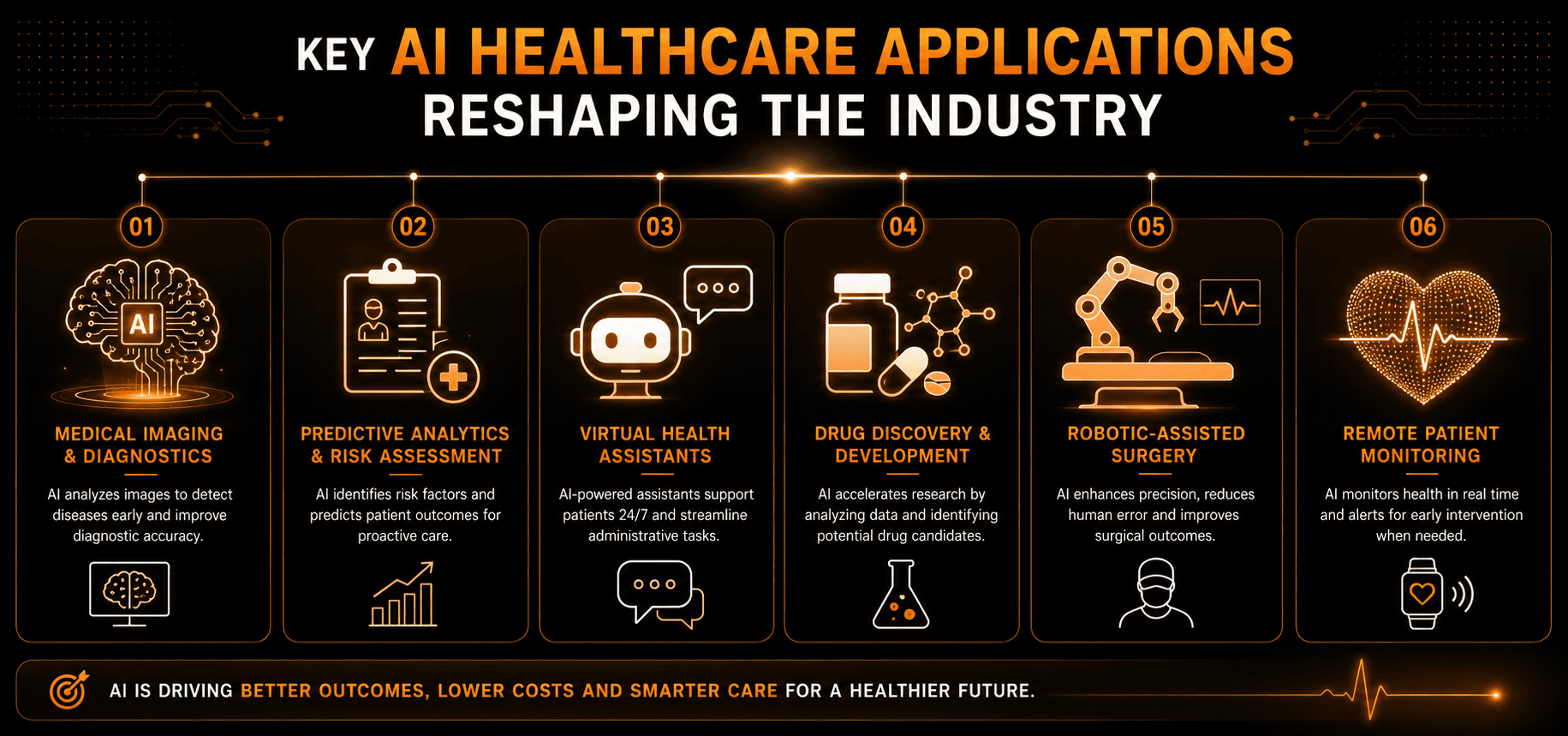
- AI for Diagnosis in Healthcare
AI-powered imaging technologies help radiologists analyze X-rays, MRIs, CT scans, and mammograms. Such technologies can help experts to prioritize cases and quickly spot anomalies. This is particularly useful for hospitals with a large number of patients as it speeds up diagnosis. From imaging analysis to patient engagement, AI is changing the way healthcare is delivered. To see how we apply similar AI-driven technology in other sectors, visit our AI-powered game systems
- Patient Engagement
Modern AI patient care solutions allow healthcare professionals to keep in touch with patients without the need for traditional clinic visits. AI-powered assistants can help users with follow-up care instructions, scheduling appointments, reminding patients to take their medications and responding to frequently asked questions from patients. Many of these capabilities are now powered by enterprise AI assistants designed for healthcare environments, which help automate patient communication and support medical workflows. This may sound simple, but it deals with a big problem in healthcare: communication gaps. Patients expect better responsiveness and accessibility from their healthcare experiences. AI helps healthcare companies meet these demands without putting more strain on already overburdened employees.
- Healthcare Administration
Repetitive administrative tasks are a major source of healthcare inefficiencies. A substantial amount of staff time is taken up by workflows that include claims processing, insurance verification, paperwork, scheduling, and invoicing. This makes healthcare process automation using AI one of the most sensible areas for hospitals and healthcare networks to invest in. Organizations are using AI to streamline processes that have historically slowed down their operations, reduce manual paperwork, and improve billing accuracy.
How AI Is Improving Operational Efficiency in Healthcare?
Operational pressure is a key driver for healthcare companies’ investments in AI as U.S. hospitals are grappling with rising patient volumes, escalating administrative costs and staffing shortages. Healthcare executives are realizing that more staff isn’t always the answer. AI is not only improving patient care but also streamlining administrative tasks to boost hospital efficiency. To learn more about our AI-driven operational solutions, take a look at our Blockchain-based AI solutions.
And AI is allowing businesses to work smarter without compromising the care of patients. AI is allowing healthcare systems to work smarter, with McKinsey reporting cost reductions of 15–20%, while IBM studies show an average return of over $3 for every $1 invested in healthcare AI.
- Planning of Hospital Resources
AI technologies allow for real-time analysis of staffing needs, ICU occupancy trends, ER demand and patient admission patterns. This allows administrators to provision resources more efficiently, rather than constantly reacting to shortages.
- Support for Documentation
Believe it or not, doctors spend most of their time doing paperwork and computer records. Now, AI-powered documentation systems can create medical notes during patient visits, allowing physicians to spend more time with patients and less time on paperwork. Many of these documentation tools are powered by generative AI systems that reduce manual workload for healthcare professionals. This is important as physician burnout remains one of the biggest problems facing the healthcare industry.The healthcare AI automation benefits are often more practical than people believe. While these may not sound revolutionary, faster workflows, less manual labor and better coordination directly impact the quality of healthcare.
- Billing and Claims Management
AI systems can identify claim risks, missing data and inconsistent coding before submissions are processed. This reduces income leakage, improves financial efficiency and minimizes delays. All of this helps improve healthcare efficiency with AI.
AI in Healthcare: Real Use Cases That Deliver Results
When we look at how healthcare organizations are actually using AI, the conversation around it takes on far greater significance.
- Mayo Clinic has invested heavily in research related to AI-powered predictive analytics and diagnostics. Their teams are investigating how machine learning can help with more personalized treatment planning and early disease detection.
- The Cleveland Clinic has also been looking at predictive AI models in cardiovascular care. If doctors can identify high-risk patients early on, they can act faster and possibly prevent major problems.
- AI is also having a noticeable impact in the field of emergency medicine. AI’s real-world applications are already delivering results, from predictive analytics to emergency medicine.For further insight on how AI is being applied across industries, read ChicMic’s blog on The Growing Impact of Healthcare Mobile App Development.
Many hospitals today use AI-based stroke detection systems that analyze imaging scans to immediately notify specialists when signs of a stroke are detected. A few minutes of emergency care can make a huge difference in patient outcomes.
The popularity of virtual health assistants is also on the rise. AI assistants are becoming more common in healthcare systems, helping patients schedule appointments, remember to take their prescriptions, and check in on instructions. These technologies are increasing access and decreasing administrative burden, but they are not a replacement for medical staff.
The ideas are not in the experimental stage any longer. In fact, they are useful real-world AI healthcare applications.
AI vs Traditional Healthcare Systems: What’s the Real Difference?
Traditional healthcare systems are often reactive. Often, treatment is given to patients only after their symptoms are bad enough to require action. Workflows are spread out, administrative systems are largely manual, and providers spend significant effort coordinating data across disparate platforms.
Healthcare systems assisted by AI support are increasingly shifting towards a more proactive and predictive approach.
Healthcare firms can better coordinate care, increase efficiency, and prevent hazards before they occur rather than simply respond to problems as they happen.
| Traditional Healthcare |
AI-Enabled Healthcare |
| Reactive treatment models |
Predictive care strategies |
| Manual documentation |
Automated documentation support |
| Delayed data analysis |
Faster real-time insights |
| Limited personalization |
Personalized care recommendations |
| Administrative bottlenecks |
Workflow automation |
| Fragmented patient communication |
Continuous patient engagement |
One of the major differences is speed. But there is a challenge in processing the huge amounts of data healthcare workers already have access to. AI makes data quicker to organize and analyze, so providers don’t feel overwhelmed and can make better decisions.
Another important difference is scalability. Healthcare systems cannot scale patient services using manual operational methods alone. AI enables businesses to attend to larger patient volumes more efficiently and with quality of service. As a result, many healthcare executives now consider AI an operational necessity and not a fad.
The Challenges of Implementing AI in Healthcare
Despite the optimism around AI, implementation is not simple. There are a number of key challenges for healthcare organizations in integrating AI systems into clinical and operational workflows.
- Data Privacy
AI technologies need large data sets and health care systems handle highly sensitive patient data. This presents challenges for patient privacy, cybersecurity, and legal compliance. To better understand how to mitigate data privacy risks in AI, visit our AI Portfolio for detailed solutions
- Trust
The recommendations of AI should not be blindly trusted by healthcare providers. Doctors need systems that are clear, understandable and clinically sound. This is why human oversight remains a critical component of modern AI in healthcare decision-making. AI assists in decision making but patient care remains in the hands of medical personnel.
- Bias
AI systems are only as good as the training data they’ve been fed. When training data are not diverse, recommendations for certain patient groups may be less reliable.
- Integration
Many hospitals still operate on legacy infrastructure that was never designed to support cutting-edge AI technologies. Introducing new technology into existing systems is often a major financial and operational undertaking.These challenges don’t render AI useless. They only stress the need for reliable implementation strategies, not rapid adoption, in healthcare companies.
How AI Improves Patient Outcomes and Experience?
One of the biggest impacts AI is having on the healthcare industry is its ability to improve patient outcomes while also making care feel more seamless and less stressful.
Early detection of disease is an important issue. AI can look at patient data and find small warning signs that may otherwise be missed. This is especially important in oncology, cardiology, and chronic disease management where early detection often leads to better treatment outcomes and fewer problems. With AI, healthcare providers can detect health issues earlier, leading to better treatment outcomes. To explore how we implement AI solutions in mobile apps for healthcare, check out our Mobile App Development services
AI is also making care more personal. Instead of relying on generic treatment regimens, healthcare professionals can take advantage of AI-driven insights based on a patient’s history, risk factors, and behavior patterns. This results in more targeted and successful treatment plans.
Another area that is really improving is the communication with the patients. Healthcare has suffered from poor coordination, long waits and slow updates for a long time. AI helps close these gaps by improving appointment scheduling, sending reminders and improving patient-provider communication.
Remote monitoring is also gaining popularity. Thanks to AI-enabled solutions, doctors can continuously monitor patients with chronic diseases such as diabetes or hypertension. This reduces unnecessary hospitalizations, and allows for early detection of problems.
Automation is not the only objective, as a rule. The aim is to create a more connected, proactive and patient-centric healthcare system.
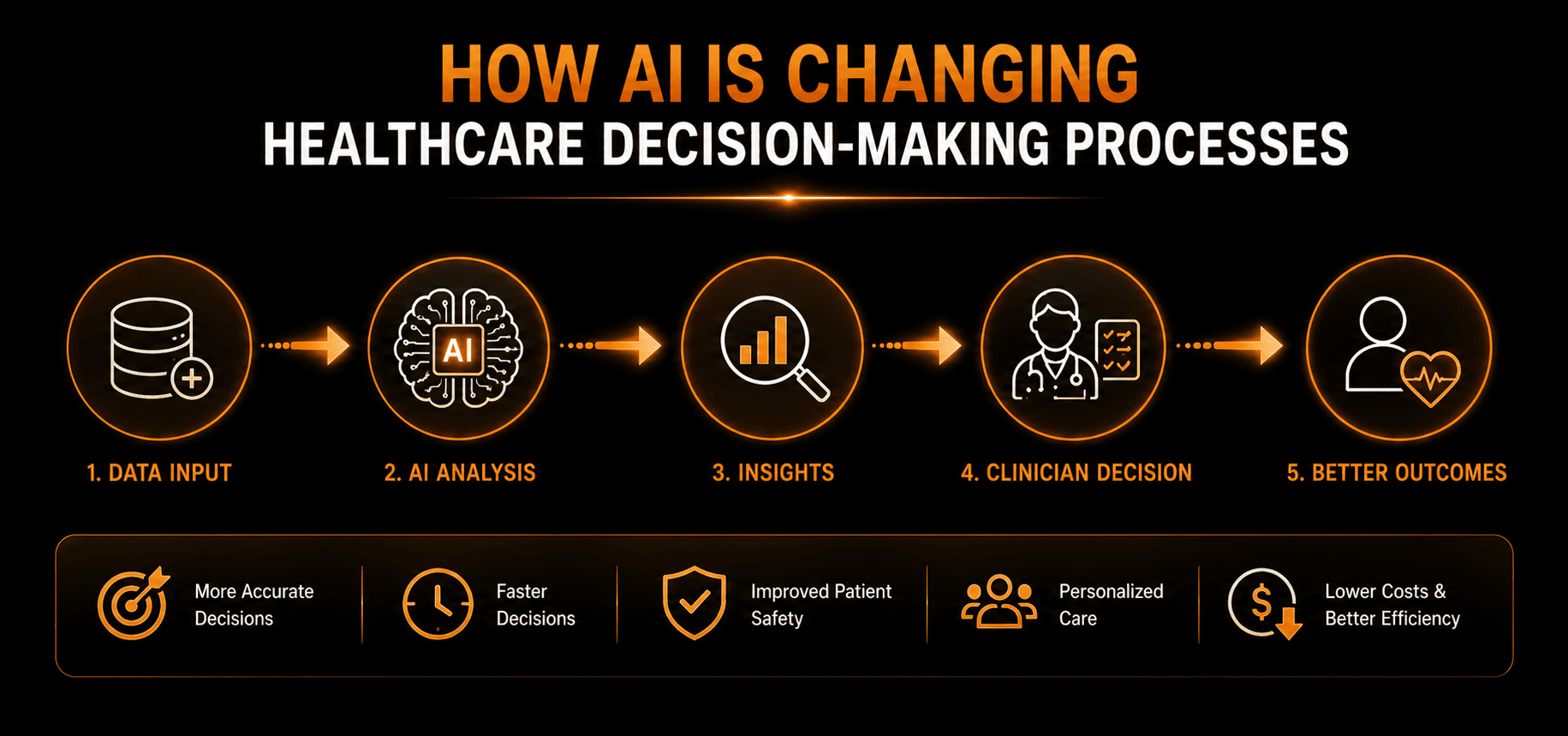
How AI Is Changing Healthcare Decision-Making Processes?
Healthcare decision-making is increasingly data-driven due to physician’s need to manage large volumes of complex medical data.
- The Growing Complexity of Clinical Decisions
Modern clinicians have to contend with a plethora of data, including patient histories, imaging reports, test results, drug interactions, and evolving clinical guidelines. It is hard and time-consuming to do this manually, especially in a busy hospital.
- Where AI Adds Real Value
This is where AI is making a useful difference. Modern AI medical decision support systems can help clinicians quickly identify risks, spot anomalies, prioritize critical cases, and provide evidence-based recommendations. These tools act as a supplement, not a replacement, helping doctors make faster and more informed decisions. They are powered by machine learning models that improve over time as they process more patient data and medical outcomes.
- The Value of Human Knowledge
AI is not a substitute for medical judgement. Clinical judgments still depend on human experience, moral judgment, and knowledge of the particular circumstances of each patient. AI, on the other hand, reduces cognitive overload, enabling doctors to focus more on patient care and less on data processing.
- Better Early Intervention
Predictive analytics technologies, for example, can use past data patterns to identify patients who are more likely to have difficulty. This allows doctors to intervene earlier, often before a problem escalates.
- The Major Change in Healthcare Approach
This AI integration is also changing the way healthcare organizations approach clinical and operational decision-making. Systems can now anticipate problems and be more proactive, rather than reactive.
Ultimately, artificial intelligence in healthcare administration will depend on a healthy balance of human expertise and AI-driven insights, rather than full automation.
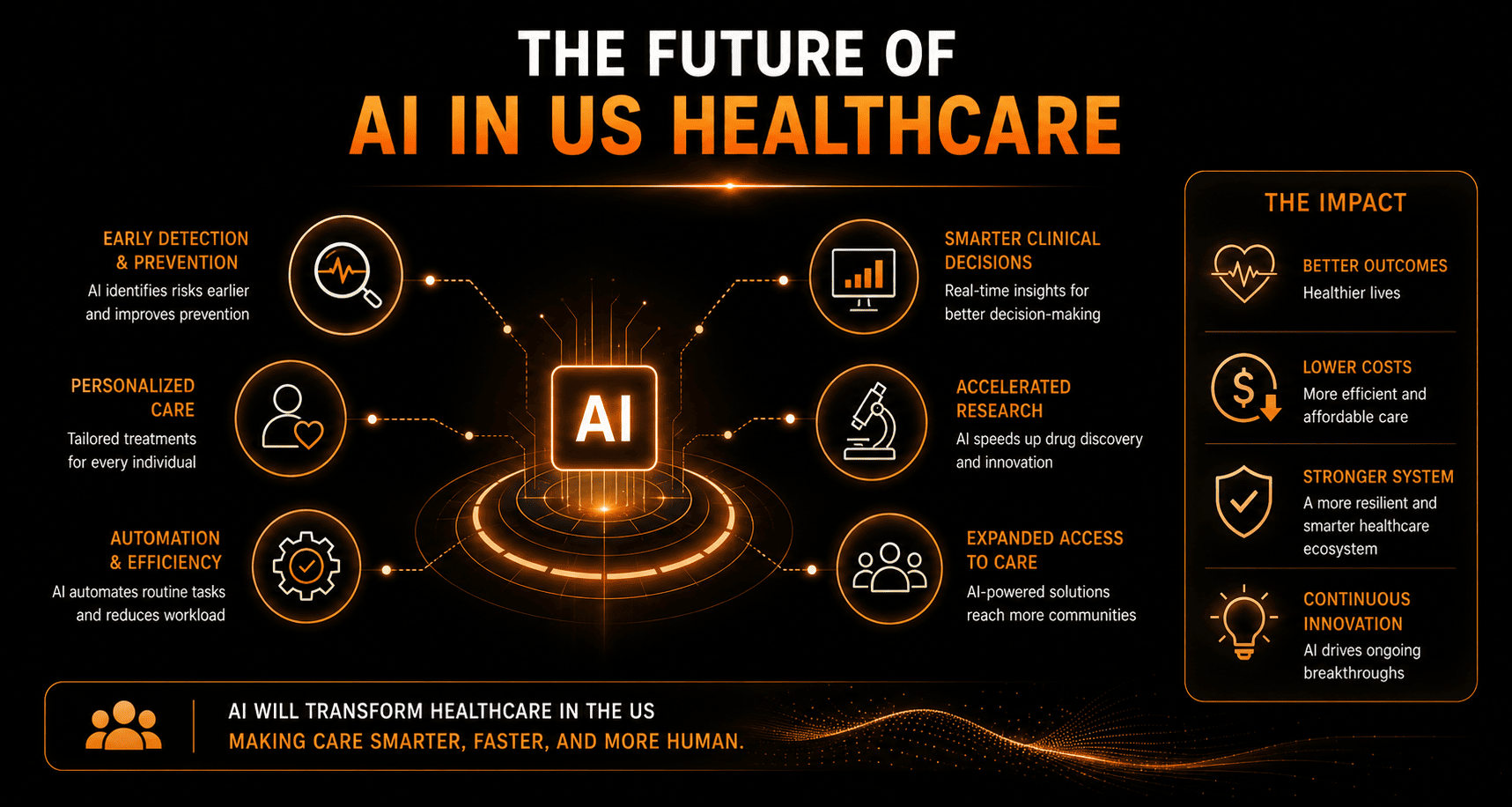
The Future of AI in US Healthcare: Beyond the Hype
The future of AI in healthcare will be far more realistic than the sometimes futuristic visions portrayed in science fiction. The real way forward is AI-assisted healthcare technologies that discreetly improve workflows, support medical decisions, and reduce operational burdens in the background, not fully automated hospitals. The future of AI in healthcare will focus on smart, scalable, and integrated technologies. To understand how these technologies are evolving, explore our AI-powered blockchain innovations
- Moving from hype to real impact
The next phase of artificial intelligence changing our healthcare systems will be about quantifiable results rather than experimentation. Health care companies are no longer just using AI to keep up. They are targeted on tangible advances in day-to-day medical operations, patient care and efficiency.
- Where is the real growth?
AI growth is anticipated in areas that directly assist doctors and patients. They include predictive population health analytics, drug development assistance, personalized treatment plans, remote patient monitoring, and AI tools for medical documentation.All of these are connected by a simple goal. Healthcare teams want to spend more time delivering actual patient care, and less time doing mundane chores.
- Why will governance increasingly matter?
As AI becomes more common in healthcare systems, stronger oversight will be needed. Healthcare professionals should emphasize patient consent, explainability, ethics, and transparency. Without these foundations, even the most sophisticated tools will be hard pressed to gain trust in real clinical settings.
- What will be success?
The companies taking advantage of the most advanced technology will not always be the ones that benefit the most from AI. They will be the ones to responsibly use AI to solve real healthcare problems at scale.Ultimately, success in healthcare is not determined by technology. It is defined by the results, trust and the degree to which patient well-being is protected and promoted.
Conclusion: The Real Value of AI in Healthcare in 2026
Finally, even the healthcare sector is abandoning its irrational AI dreams. The real debate is not whether AI will replace doctors, but how AI can help systems that are under a lot of pressure right now. We are already witnessing the effects of AI’s transformation of our healthcare systems in the areas of hospital operations, diagnostics, patient care and administrative workflows. It’s driving productivity, reducing drudgery and better, faster decisions.
But for it to be effective, it still needs strong governance, data security and human oversight to make sure it is used responsibly and safely. Healthcare will be smarter, more efficient and more connected in the next decade, but it will not be fully automated. In 2026, AI will have a more profound impact on healthcare, but strong governance and human oversight will remain essential. Learn how we ensure responsible AI practices with our AI-first solutions.
Frequently Asked Questions
1. What is the real impact of AI in US healthcare?
AI is improving operational efficiency, supporting faster diagnosis, reducing administrative workload, and helping healthcare providers make better-informed decisions.
2. How is AI being used in patient care?
AI is being used for virtual health assistants, remote monitoring, predictive analytics, personalized treatment recommendations, and automated patient communication.
3. What are the benefits of AI in healthcare?
The biggest benefits include better efficiency, improved patient experiences, workflow automation, faster data analysis, and stronger medical support systems.
4. How does AI improve healthcare decision-making?
AI helps clinicians analyze large datasets faster and identify risks or patterns that may support more accurate and timely decisions.
5. What are the challenges of AI in healthcare?
Common challenges include data privacy concerns, cybersecurity risks, integration difficulties, AI bias, and trust in AI-generated recommendations.
6. What AI tools are used in healthcare?
Healthcare organizations use AI-powered imaging systems, predictive analytics tools, virtual assistants, documentation software, and decision support platforms.
7. Will AI replace doctors in healthcare?
No. AI is designed to support healthcare professionals, not replace them. Human judgment and patient interaction remain essential.
8. How can healthcare organizations adopt AI effectively?
Healthcare organizations can adopt AI by integrating it gradually into existing systems, focusing on specific use cases like administration or diagnostics, while maintaining human oversight and minimal workflow disruption.